
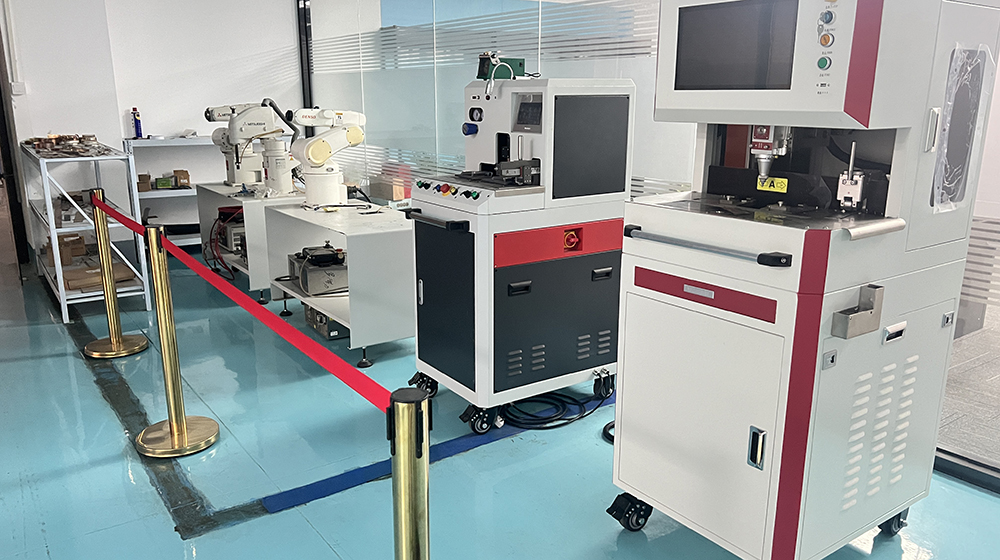
Differences: Fiber vs Spot Laser Welding Machine
Fiber laser welding machines and laser spot welding machines differ significantly in various aspects. A detailed analysis of their differences is presented below:
1. Working Principles & Application Scenarios
Fiber Laser Welding Machine
Working Principle: It leverages the high-energy and high-density properties of laser beams to heat small local areas inside materials. Thermal conduction drives internal heat diffusion of the materials, and a specific molten pool is then formed inside the materials to achieve welding.
Application Scenarios: Suitable for welding various materials including metals, and widely used in aerospace, automobile manufacturing, electronics, medical care and other fields. Specifically, automated laser welding machines are mainly used for the automated welding of circular, linear and other seams on metal materials, and are extensively applied in mobile phones, watches, electronic components, precision instruments, handicrafts and other industries; laser mold repair welding machines are primarily used for mold welding in digital products, mobile phones, automobile, motorcycle and other industries, and also widely adopted in manual welding operations.
Laser Spot Welding Machine
Working Principle: It also uses laser as the heat source, but is typically designed for spot welding on small welding areas.
Application Scenarios: Mainly used for the repair welding of gold and silver jewelry, electronic components, as well as spot welding for sand holes on valves and other parts. With its characteristics of high precision, non-contact operation, high efficiency and energy saving, it can meet the diverse welding requirements of different industries.
2. Welding Effects & Features
Fiber Laser Welding Machine
Welding Effect: Narrow weld seams, firm welding with high fracture resistance, smooth and aesthetically pleasing welds, and no or only simple post-weld treatment required.
Features: High efficiency, high precision, energy saving and environmental protection, flexible automation, easy maintenance, high reliability, high-quality laser beam, etc. Meanwhile, it can be adjusted according to different production requirements, boasting strong flexibility.
Laser Spot Welding Machine
Welding Effect: The weld penetration depth is shallower than that of traditional welding, and the welding parameters are more easily controlled. However, identical structural parts welded in the same batch may have weld defects, such as layered superposition at the joints which impairs the appearance and requires post-treatment. Welding deformation is also a common issue.
Features: High precision – it adopts a variety of sensing technologies to realize high-precision automatic and non-contact welding, ensuring high welding quality and fast speed. In addition, it has no interchangeable parts, can be customized, and is suitable for welding various materials such as stainless steel, copper, aluminum, titanium, steel and so on.
3. Operation & Maintenance
Fiber Laser Welding Machine
Operation: Usually equipped with advanced welding control software, featuring simple operation, flexible editing, strong compatibility and excellent controllability.
Maintenance: Compact structure and easy maintenance, which reduces users' maintenance costs and time.
Laser Spot Welding Machine
Operation: Relatively simple to operate, but may require certain adjustments based on specific welding needs.
Maintenance: Relatively low maintenance costs, but the specific maintenance requirements may vary depending on the equipment model and service environment.
In summary, fiber laser welding machines and laser spot welding machines differ remarkably in working principles, welding effects and features, as well as operation and maintenance. When selecting the appropriate equipment, a comprehensive consideration of specific welding requirements and working environments is essential.
Post a comment